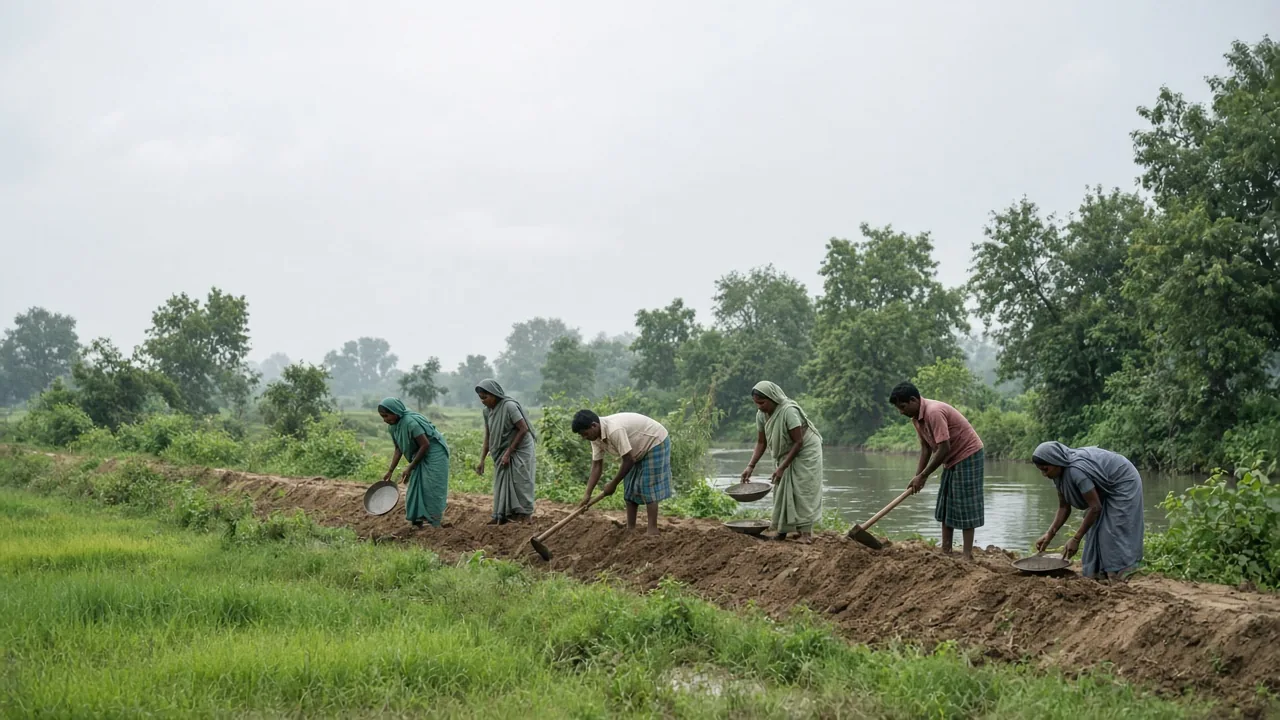
Rural employment guarantee
MGNREGA job card, wages and 125 days of work
From 1 July 2026 the guarantee continues under the VB-G RAM G Act: a recognised card, a notified daily wage, and 125 days of work in a financial year. This website does not take applications.
This website will not ask for a job-card number, Aadhaar, phone number or OTP.
Start with the step you need
Four common tasks. Lists, muster rolls and payment reports stay on government sites.
Job card
Existing e-KYC cards stay valid until a Gramin Rozgar Guarantee Card is issued. New households apply at the Gram Panchayat.
Wage rates
Official daily rates from Gazette S.O. 3518(E), 30 June 2026, in force from 1 July 2026. No rate is below ₹300.
Demand work
125 days in a financial year. Demand orally, on Form 6, or through official digital channels. Work is due in 15 days.
Official lists
Job-card lists, muster rolls and payment reports live on official .gov.in and .nic.in portals, not on mnrega.in.net.
Wage for N days in my State
The calculator uses the official unskilled rates in S.O. 3518(E), dated 30 June 2026. Choose the official area where a State is split. Actual wages follow days accepted on the muster roll.
Notified daily rate
Choose a State or official area and a number of days. The result is days multiplied by the official daily rate.
Gazette of India S.O. 3518(E), dated 30 June 2026, effective 1 July 2026.
| Andhra Pradesh | Whole State / UT | ₹312 |
| Bihar | Whole State / UT | ₹300 |
| Gujarat | Whole State / UT | ₹300 |
| Haryana | Whole State / UT | ₹409 |
| Himachal Pradesh | Scheduled areas | ₹375 |
| Karnataka | Whole State / UT | ₹382 |
| Kerala | Whole State / UT | ₹401 |
| Maharashtra | Whole State / UT | ₹317 |
| Odisha | Whole State / UT | ₹300 |
| Rajasthan | Whole State / UT | ₹300 |
| Sikkim | Gram Panchayats Gnathang, Lachung and Lachen | ₹450 |
| Tamil Nadu | Whole State / UT | ₹345 |
| Uttar Pradesh | Whole State / UT | ₹300 |
| West Bengal | Whole State / UT | ₹300 |
Excerpt only. Every State and Union Territory, including split areas, is on the wage rates page. Source: Gazette S.O. 3518(E), 30 June 2026, effective 1 July 2026.
How the work year runs
From a recognised card to a wage in an account, with a public record at the end.
What changed on 1 July 2026
The 2005 Act stands repealed. The guarantee continues, with a longer statutory year and a new wage notification.
Official government addresses
Lists, muster rolls and payment reports belong on these hosts. nrega.nic.in officially redirects to nrega.dord.gov.in.
Last reviewed: 11 November 2026.
If you search for MGNREGA, MNREGA or NREGA, you are looking for India’s rural employment guarantee: a job card for your household, a notified daily wage, a right to demand work, and a way to see attendance and payments. Those everyday names are still the ones people use. The law that now carries the guarantee is the Viksit Bharat – Guarantee for Rozgar and Ajeevika Mission (Gramin) Act, 2025, often shortened to VB-G RAM G. It came into force on 1 July 2026. From the same date the Mahatma Gandhi National Rural Employment Guarantee Act, 2005 stands repealed.
The sections below map what that means for a rural household. It covers job cards, the official wage rates for 2026-27, how to demand 125 days of work, how wages are paid, social audit, and the official portals where lists, muster rolls and payment reports are published. This website does not take applications, and it will not ask for a job-card number, Aadhaar, phone number, bank detail or OTP.
What the rural employment guarantee is now
For many years the guarantee sat in the 2005 Act: at least 100 days of unskilled wage employment in a financial year for every rural household whose adult members volunteered to do the work. That is the version most older pamphlets, state websites and search results still describe.
Parliament replaced that statute with the 2025 Act. The Central Government appointed 1 July 2026 as the date on which the 2005 Act, and the rules and schemes made under it, stood repealed. The new Act has been implemented across rural India from that day, and States and Union Territories have notified their schemes under it. Ongoing works were not meant to be abandoned; official guidance says they may continue under the new law and should be prioritised for completion.
The core promise is familiar, and it is larger. Every rural household whose adult members volunteer for unskilled manual work has a statutory guarantee of 125 days of wage employment in a financial year — 25 days more than under the 2005 Act. Work is still demanded at the Gram Panchayat, still due within 15 days, and still paid as a notified daily wage into a bank or post office account. The Ministry of Rural Development remains the Union ministry in charge. You can read the change, the entitlements and the local offices in more detail on what MGNREGA is, and the law in force from 1 July 2026.
A household does not need to learn a new popular name before it can ask for work. If your panchayat, mates and neighbours still say “NREGA” or “MGNREGA”, you can use those words at the office. What matters is the current entitlement: 125 days, the wage notified for your State or area, and a card that is recognised in the current system.
Job cards and the Gramin Rozgar Guarantee Card
The card is the household record that lets adult members demand work and that follows attendance and wages through the year. Under the 2025 Act the new document is called a Gramin Rozgar Guarantee Card. Official frequently asked questions published by the Press Information Bureau on 11 May 2026 say:
- If your household already has a Mahatma Gandhi NREGA job card, and e-KYC for the workers on it has been completed, that card remains valid until a Gramin Rozgar Guarantee Card is issued.
- If your household does not have a card, any adult member may apply at the concerned Gram Panchayat by submitting the names, ages and address of the household.
Employment is not supposed to be refused only because e-KYC is still pending. Official material says arrangements should be made to complete e-KYC, including at worksites where needed.
This website cannot issue a card, renew one, or show you a live “status”. The place to apply is the Gram Panchayat. The place to look at an official list of cards in a village is the government portal, starting from nrega.nic.in, which sends you on to nrega.dord.gov.in. The steps, and a warning about lookalike websites, are on the job card page and the official portal page.
Wage rates for 2026-27, by State and UT
Daily wages for unskilled manual work are notified by the Central Government. The rates now in force are in Gazette notification S.O. 3518(E), dated 30 June 2026, issued under section 10 of the 2025 Act, and they apply from 1 July 2026.
No rate in that Schedule is below ₹300 a day. That floor is the interim base wage described in official replies in 2026. The highest ordinary State rate in the Schedule is Haryana, ₹409. Goa is ₹406, Kerala ₹401, Karnataka ₹382 and Punjab ₹360. Three entries are split by area: Himachal Pradesh (non-scheduled areas ₹300, scheduled areas ₹375), Sikkim (₹300, or ₹450 in the Gram Panchayats of Gnathang, Lachung and Lachen), and the Andaman and Nicobar Islands (Andaman District ₹348, Nicobar District ₹367).
A Lok Sabha reply of 21 July 2026 gives a national average of ₹327.4 a day under the new scheme, compared with ₹298.8 under Mahatma Gandhi NREGS in 2025-26. Averages are useful context; they are not what a worker is paid. Payment follows the rate notified for the State or area where the work is done, for the days accepted on the muster roll.
The wage rates page has the full official table and a calculator: choose a State or area, enter a number of days from 1 to 125, and see days multiplied by the notified daily rate. A short excerpt sits with the calculator. The wage page lists every State and Union Territory.
Example: 125 days in Uttar Pradesh at ₹300 is ₹37,500. 100 days in Haryana at ₹409 is ₹40,900. Those multiplications assume every day is accepted on the muster. The calculator will say the same thing, with the Gazette date and a link to the official PDF.
125 days of work, and how to demand it
The statutory guarantee is 125 days in a financial year, not the 100 days that older pages still announce. Adult members demand work through the Gram Panchayat. Official frequently asked questions say a demand may be made orally, in writing on the same Form 6 used earlier, or through digital platforms, and may be given to the Gram Panchayat, the Programme Officer, or any authorised person.
Employment must be provided within 15 days of the application. If it is not, unemployment allowance is payable by the State Government: at least one-fourth of the notified wage for the first 30 days in the financial year, and at least one-half of the notified wage for the remaining period.
Work should, as far as possible, be within 5 kilometres of the applicant’s village. If it is given farther away, but still inside the Block, an extra 10% of the wage rate is payable for transport and living expenses.
States must also notify a period covering peak sowing and harvesting seasons during which works under the Act are not taken up. The Act provides for that pause to add up to 60 days in a financial year, which a State may notify separately for districts, blocks or Gram Panchayats. The 125-day guarantee still applies across the rest of the year. The demand for work page walks through each of these rules, including attendance at the worksite.
Payments, attendance and delay compensation
Wages are to be paid weekly, or at any rate not later than a fortnight after the muster roll is closed. They are paid by direct benefit transfer into the worker’s own bank or post office account.
If wages are not paid within 15 days of the muster closing, the worker is entitled to delay compensation of 0.05% of the unpaid wages for each day of delay.
Attendance is recorded with a face-authentication system, with an official exception route for genuine cases such as a dead network, a failed device, or similar problems. A mate’s phone and the National Mobile Monitoring System are field tools; they are not a public “check my payment” form on this website. Measurement of the work, the wage list and the Fund Transfer Order sit behind the payment. If you need to see a payment or an FTO, use the official portal or the official PFMS FTO search, or ask at the panchayat — the links are on the payments page.
Social audit and public information
The scheme is meant to be checked in public, not only on a screen. A Janata Board is to be displayed at every worksite, with the details of the work, estimated labour days, material quantities and item-wise costs. There is a system of weekly public disclosure, including digital and physical displays of key figures, muster rolls, payments and sanctions, and Gram Panchayats are to hold weekly disclosure meetings. Social audit is the organised way a village can test whether the people who worked were paid, and whether the assets on the ground match the records. See social audit, Janata Boards and public records.
Official portals (outbound only)
The older address https://nrega.nic.in/ is still the one many people type. The official page there now redirects to https://nrega.dord.gov.in/. Ministry pages live at rural.gov.in and dord.gov.in. The wage notification PDF is on an official NIC host, linked from the wage rates page. A VB-G RAM G software portal is also published on the Department of Rural Development’s domain at vbgramg.dord.gov.in.
A genuine official site for this scheme ends in .gov.in or .nic.in. It will not charge you a fee to see a job-card list, and this website will never ask you to type a job-card number, Aadhaar, OTP or bank password to “check status”. If a page does that, leave it and go to the official portal page or to the Gram Panchayat.
Common questions
Is MGNREGA still the law?
The 2005 Act stands repealed from 1 July 2026. The rural employment guarantee continues under the VB-G RAM G Act, 2025, with 125 days of work in a financial year and new notified wages from the same date.
Can I still use my old job card?
Yes, if e-KYC for the workers on it has been completed. Official FAQs say it remains valid until a Gramin Rozgar Guarantee Card is issued.
What is the wage in my State?
Use the state-wise table and calculator, which follow Gazette S.O. 3518(E) of 30 June 2026, effective 1 July 2026. There is no single all-India daily wage.
Is the guarantee still 100 days?
No. The current statutory guarantee is 125 days in a financial year.
Can this website show my payment or my job-card status?
No. Lists, muster rolls and payment reports are on official government portals. This site only explains the rules and links to those portals.