Social audit
MGNREGA social audit, Janata Boards and public records
सामाजिक अंकेक्षण, जनता बोर्ड और सार्वजनिक रिकॉर्ड
Last reviewed: 11 November 2026
The rural employment guarantee is a public right, and the records that support it are meant to be public too. Official frequently asked questions published on 11 May 2026 describe three everyday tools for that: a Janata Board at every worksite, weekly public disclosure of key figures, and social audit. Together they are how a village can test whether the people who worked are the people who were paid, and whether the pond, road or bund on the ground matches the file.
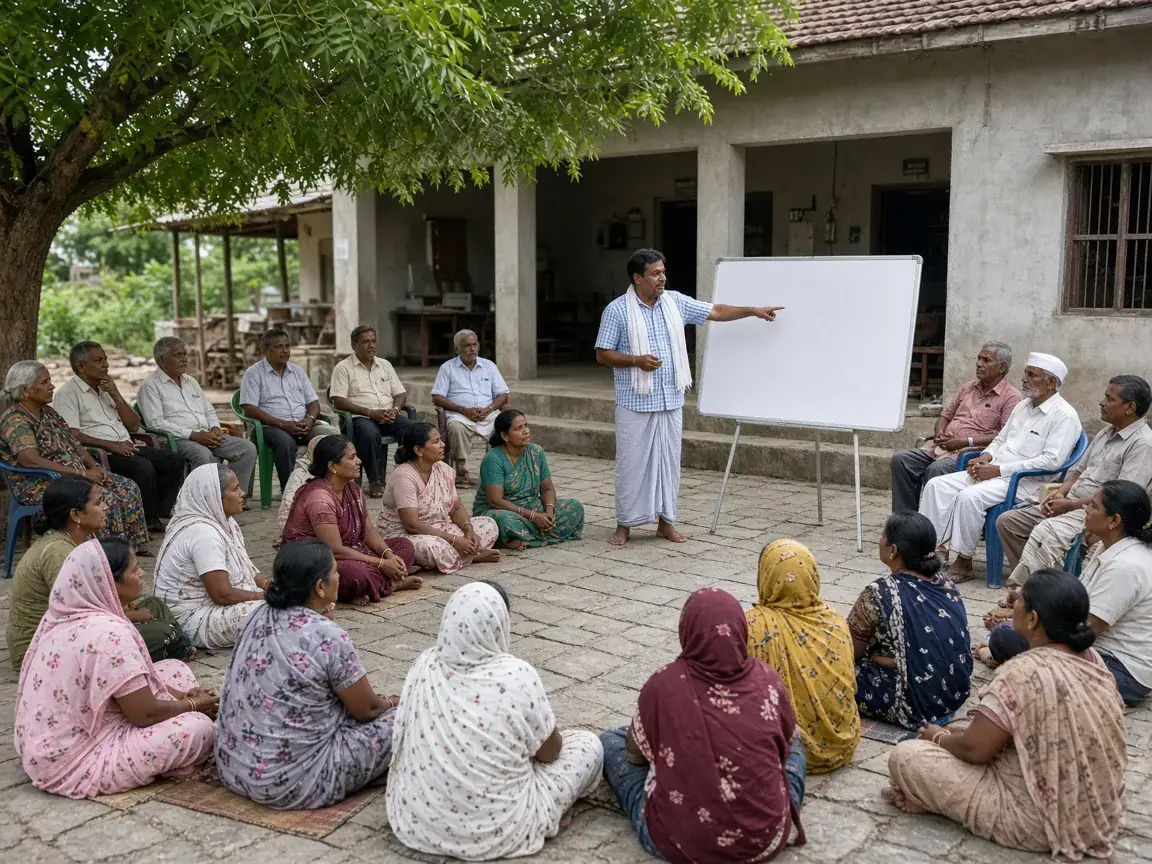
The sections below explain those tools in plain language. It does not replace a social-audit meeting, and it does not host official muster rolls. The rolls themselves are on official portals and in the Gram Panchayat’s registers.
What a social audit is for
A social audit is a public examination of the scheme’s records and of the works on the ground, usually with the Gram Sabha at its centre. It is not a polite display of posters. It is the chance to read a muster roll aloud, to ask why a name is missing, why a payment is late, or why a work shown as complete is not complete, and to record what the village finds.
Social audit sits alongside official inspections, not instead of them. Findings are meant to lead to action: a correction in the register, a delayed wage, or a further enquiry. If you have a specific complaint about attendance or payment, you can also use official grievance routes described on the payments page, and you should still take the same facts to the social-audit process so that they are on the public record.
The people who should be able to take part are the workers, other residents of the Gram Panchayat, and the facilitators appointed for the audit. The implementing staff should produce the records, not control the conclusions.
The Janata Board at the worksite
Official FAQs say a Janata Board must be displayed at every worksite, showing:
| Item that should be visible | Why it matters |
|---|---|
| Details of the work | So everyone can see what has been sanctioned, not only a short spoken description |
| Estimated labour days | So the village can compare planned person-days with the muster |
| Material quantities | So material, if any, is not invisible |
| Item-wise costs | So the labour and material split can be checked against the 40% district material cap described in official FAQs |
If a worksite has no board, or the board is blank, out of date, or kept in an office instead of at the work, that is itself a fact worth raising with the mate, the Gram Panchayat and, if needed, the Programme Officer. The board is for the people standing on the site, including those who do not read a portal.
Weekly public disclosure
Official FAQs also describe weekly public disclosure systems, including digital and physical displays of key metrics, muster rolls, payments and sanctions. Gram Panchayats are to hold weekly disclosure meetings.
That weekly rhythm is faster than an annual pamphlet. A worker who thinks last week’s attendance is wrong should not have to wait for a yearly audit to say so. The meeting is also a place to hear which works will open next, which demands for work are pending, and whether wages have gone out after a muster closed.
Physical displays should be in a place people actually pass — the panchayat building, a notice wall, the worksite itself — not only on a login page. Digital displays belong on official government sites, not on unofficial “status” pages.
The Gram Sabha’s role
The Gram Sabha is the village’s general assembly. Official FAQs already give it a planning role: works under the Act must come from a Viksit Gram Panchayat Plan prepared by the Gram Panchayat and approved by the Gram Sabha, as explained on what the law is now. The same assembly is the natural public for social-audit findings and for questions about musters and payments.
Every adult member of a rural household has a reason to attend: the plan decides which works will be available when you demand employment, and the audit decides whether last season’s work and wages stand up to the light. If a meeting is called at a time or place that shuts people out — for example, without notice, or when women workers cannot attend — that is a problem to raise with the panchayat and the Programme Officer.
Records you can ask to see
You should be able to ask, at the Gram Panchayat and on the official portal, for:
- the job-card or registration list
- demand applications and work allotments
- muster rolls, including attendance
- payment and FTO reports
- the list of works, with photographs and expenditure where official reports show them
- social-audit observations and action-taken notes, where they have been recorded
Start at nrega.nic.in, which redirects to nrega.dord.gov.in. If a report will not load, the paper or locally held register at the panchayat is still a public record. This website will not ask you to type a job-card number to “reveal” those records.
What a worker can take to the meeting
You do not need a lawyer’s file. Useful papers are simple: the job card, a note of the days you worked and the worksite, any demand acknowledgement, the passbook, and, if you have them, a copy of a muster page or a payment report printed from the official portal or given by the panchayat. If you cannot read the report, ask a trusted literate neighbour, a social-audit facilitator, or the person reading the roll aloud to go through your name with you in the meeting, not only afterwards in a corridor.
Questions that often belong in the open meeting include: names on the muster of people who did not work; days you worked that are not on the roll; works shown as complete that are incomplete or not where the file says; material billed but not visible; and wages that have passed the 15-day point without delay compensation. Officials should answer in the meeting, and the answer should be written down.
If a meeting is dominated only by implementing staff, or if records are not produced, record that fact too, and take it to the Programme Officer and the District Programme Coordinator. Social audit is weakened when the only copy of the muster is on a locked computer.
Frequently asked questions
What is a Janata Board?
A public board at the worksite showing the work, estimated labour days, material quantities and item-wise costs.
How often should records be disclosed?
Official FAQs describe weekly public disclosure and weekly disclosure meetings at the Gram Panchayat.
Can I see the muster roll?
Yes, through official reports and at the panchayat. This site does not host rolls.
Is social audit the same as a government inspection?
No. It is a public audit with the village, using official records and what is on the ground. Inspections can happen as well.
Related pages
125 days of work: how to demand employment
Eligible rural households can demand 125 days of work in a financial year. Employment is due in 15 days, or unemployment allowance is payable.
MGNREGA wage payments, DBT and delay compensation
Wages go by direct benefit transfer to a bank or post office account. If they are late after the muster closes, delay compensation is due at 0.05% a day.
Official MGNREGA and NREGA portals, lists and reports
nrega.nic.in now sends you to nrega.dord.gov.in. Use official .gov.in or .nic.in sites for job-card lists, muster rolls and payment reports.