125 days
125 days of work: how to demand employment
125 दिन का काम: रोज़गार की माँग कैसे करें
Last reviewed: 11 November 2026
The current statutory guarantee is 125 days of wage employment in a financial year for every rural household whose adult members volunteer for unskilled manual work. That figure replaced the 100 days guaranteed under the 2005 Act, from 1 July 2026. Searching for “MGNREGA 100 days” is still a sensible way to find this rule; the answer you should now expect is 125 days, together with a right to demand work and a remedy if work is not given in time.
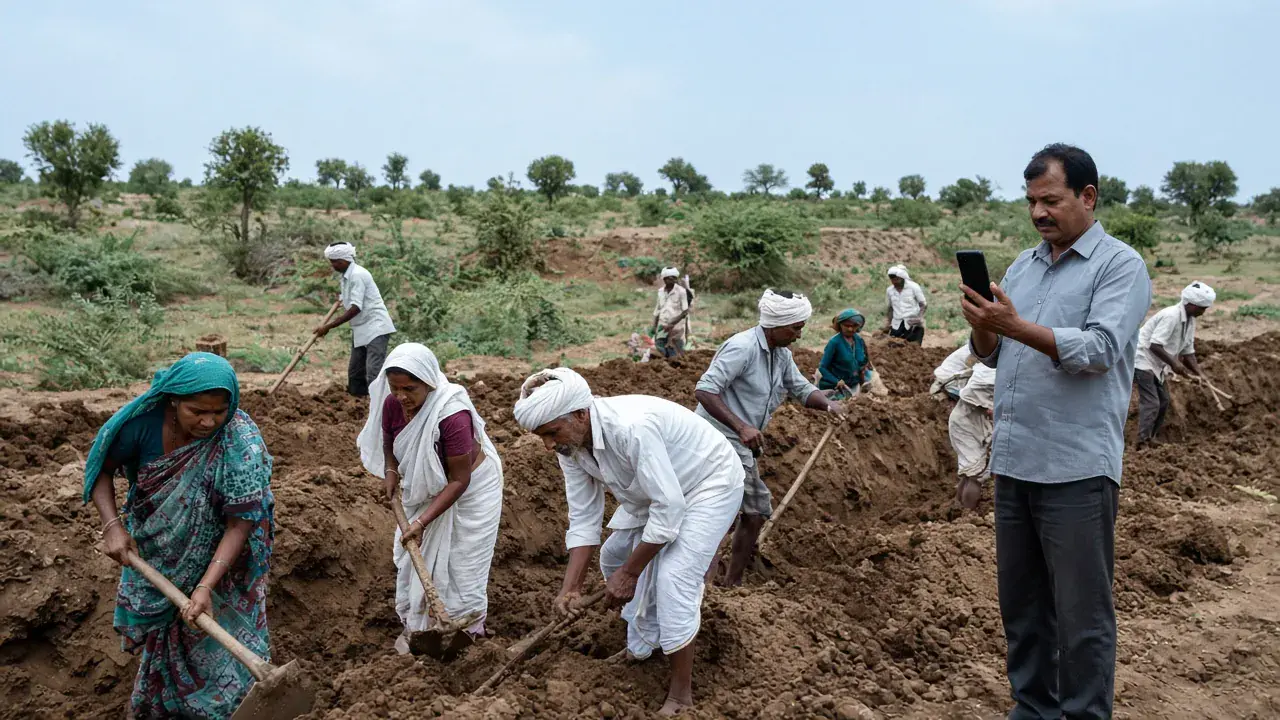
The sections below explain how to demand work, the 15-day rule, unemployment allowance, the five-kilometre rule, the agricultural-season pause, and attendance at the worksite. It assumes the household already has a recognised job card, or is applying for one at the Gram Panchayat.
From 100 days to 125 days
Official frequently asked questions published by the Press Information Bureau on 11 May 2026, and a Lok Sabha reply of 11 August 2026, both state that the guarantee has been enhanced from 100 days to 125 days in a financial year.
125 days is the legal guarantee, not an automatic roster. Days count when they are demanded, provided and accepted on the muster roll. If your household has already worked some days in the same financial year, the remaining guarantee is 125 minus those accepted days. This website will not ask for your job-card number to calculate that; you can do the subtraction yourself, or ask the panchayat to read it from the register.
Older state pages that still say “100 days” are describing the previous Act. They are not a reason to stop demanding work after 100 days under the current law.
How to demand work (oral, Form 6, digital)
Official FAQs say that adult members may demand employment through the Gram Panchayat, and that an application can be made:
- orally
- in writing, through the same Form 6 used earlier
- through digital platforms
and may be given to the Gram Panchayat, the Programme Officer, or any authorised person.
If you demand work orally, ask for a dated acknowledgement so that the 15-day clock can be shown later if needed. If you use Form 6, fill the period for which work is required and the names of the adults on the card who are asking for it. If your State has an official app or portal for demand, use that official channel; do not use an unofficial site that offers to “register demand” for a fee.
A demand is not the same as a new job-card application. If the household has no card yet, apply for the card and demand work at the panchayat, rather than waiting on a private website.
The 15-day rule
Employment must be provided within 15 days from the date of application. That official sentence is the heart of the guarantee. The 15 days run from the demand, not from the start of the financial year, and not from the day a mate happens to open a new muster.
If the panchayat offers work and a worker does not report, that is a different situation from work not being provided. Keep the acknowledgement of the demand. If work is offered more than five kilometres away, the extra allowance described below should come with it; a household should not have to refuse a distant site for lack of that 10%.
Unemployment allowance if work is not given
If employment is not provided within the stipulated period, official FAQs say the worker is entitled to unemployment allowance, payable by the State Government, at:
| When, in the financial year | Minimum allowance |
|---|---|
| First 30 days | Not less than one-fourth of the notified wage rate |
| Remaining period of the financial year | Not less than one-half of the notified wage rate |
The “notified wage rate” is the daily rate for your State or area in S.O. 3518(E). For a ₹300 State, one-fourth is ₹75 a day and one-half is ₹150 a day, as a minimum. The allowance is a legal right when work is not given in time; it is not automatic unless the demand and the delay are on the record. Ask the Gram Panchayat and the Programme Officer in writing if it is not paid.
Unemployment allowance is not a substitute for 125 days of actual work, and it is not delay compensation on a wage already earned. Delay compensation is a different entitlement, on the payments page.
Work within 5 kilometres, and the 10% extra
As far as possible, employment is to be provided within a radius of 5 kilometres of the applicant’s village. If it is provided beyond that, but still within the Block, workers are paid an extra 10% of the wage rate for transport and living expenses.
Example: in a ₹300 area, the extra is ₹30 a day when the five-kilometre rule is triggered. In Haryana, at ₹409, 10% is ₹40.90 a day. The extra is on top of the notified wage, not instead of it. Work is not supposed to be sent outside the Block under this rule.
The agricultural-season pause
To leave labour available for peak sowing and harvesting, State Governments are required to notify a period covering those peak agricultural seasons during which works under the Act shall not be undertaken. Section 6 of the 2025 Act provides that this notified pause adds up to 60 days in a financial year, and that it may be notified separately for districts, blocks or Gram Panchayats.
That does not cancel the 125-day guarantee. It concentrates scheme works in the rest of the year, so that agricultural operations are not starved of labour in the peak weeks. The exact dates are a State notification, not a single national calendar. Ask the Gram Panchayat which dates have been notified for your panchayat or block before you assume that a worksite will be open in the harvest.
Attendance at the worksite
Official frequently asked questions say attendance shall be captured through a face-authentication-based mechanism, with an exception-handling route for genuine cases such as poor or no network, technical or device problems, or other exceptional circumstances, as per government guidelines.
Worksites must offer safe drinking water, shade for children and rest periods, and a first-aid box. A Janata Board should be on display. Contractors are not allowed for works financed under the Act, and labour-displacing machines are not to be used as far as practicable.
If face authentication fails for a genuine reason, official guidance provides for an exception, including, in later official descriptions of the attendance app, offline recording where there is no network, to be uploaded once the device is in range. A worker should not lose a day’s wage only because a phone had no signal, but the exception has to be recorded through the official process, not invented later.
Keeping a record of the demand
The 15-day rule and the unemployment-allowance rule only help if the demand itself can be shown. If you apply in writing, keep a copy of Form 6 or of the official acknowledgement. If you apply orally, ask the official who takes the demand to write the date, the names, the period of work asked for, and a signature or stamp, and to give you that slip. If you apply on an official digital channel, keep the acknowledgement number.
If work is then allotted, the official communication should say the work, the place of reporting, the date to report, and the implementing agency. Arrive on that date with the card. If you cannot attend, tell the panchayat promptly so that the muster and the remaining guarantee are not left in a mess.
Households sometimes worry that demanding work in writing will annoy the panchayat. The Act is built on demand. A polite written demand is a normal use of the right, not a quarrel. If a panchayat says there is “no work”, ask whether a demand has been registered, whether the agricultural-season pause is in force, and whether incomplete works on the approved plan can be opened. Those are fair questions, and they can be repeated to the Programme Officer.
Frequently asked questions
Is the guarantee still 100 days?
No. From 1 July 2026 it is 125 days in a financial year.
How do I demand work?
Orally, on Form 6, or through official digital platforms, at the Gram Panchayat, the Programme Officer, or any authorised person.
What if work is not given in 15 days?
Unemployment allowance is payable by the State, at not less than one-fourth of the notified wage for the first 30 days of the financial year and not less than one-half after that.
Can work be stopped during the harvest?
States must notify a peak-season pause, aggregating to 60 days in a year under section 6 of the Act. Ask your panchayat for the local dates.
Does this website allot work?
No. Only the official machinery can allot a worksite.
Related pages
MGNREGA job card and the Gramin Rozgar Guarantee Card
Existing e-KYC job cards stay valid until a Gramin Rozgar Guarantee Card is issued. New households apply at the Gram Panchayat, not on this website.
MGNREGA wage rates for 2026-27, state by state
Official unskilled wage rates from Gazette S.O. 3518(E), dated 30 June 2026, effective 1 July 2026. Calculate wages for up to 125 days in your State.
MGNREGA wage payments, DBT and delay compensation
Wages go by direct benefit transfer to a bank or post office account. If they are late after the muster closes, delay compensation is due at 0.05% a day.
MGNREGA social audit, Janata Boards and public records
MGNREGA social audit, the Janata Board and weekly disclosure: how a village can check work, attendance and payments.