The law from 1 July 2026
What MGNREGA is, and the law in force from 1 July 2026
मनरेगा क्या है, और 1 जुलाई 2026 से कौन सा कानून लागू है
Last reviewed: 11 November 2026
MGNREGA is the name most people still use for India’s rural employment guarantee: a legal right of a rural household to demand unskilled wage work, at a notified daily rate, and to be paid for the days accepted on the muster roll. The statute that first created that right was the Mahatma Gandhi National Rural Employment Guarantee Act, 2005. That Act is no longer in force. From 1 July 2026 the guarantee continues under a new law, the Viksit Bharat – Guarantee for Rozgar and Ajeevika Mission (Gramin) Act, 2025 (Act 36 of 2025), often written VB-G RAM G.
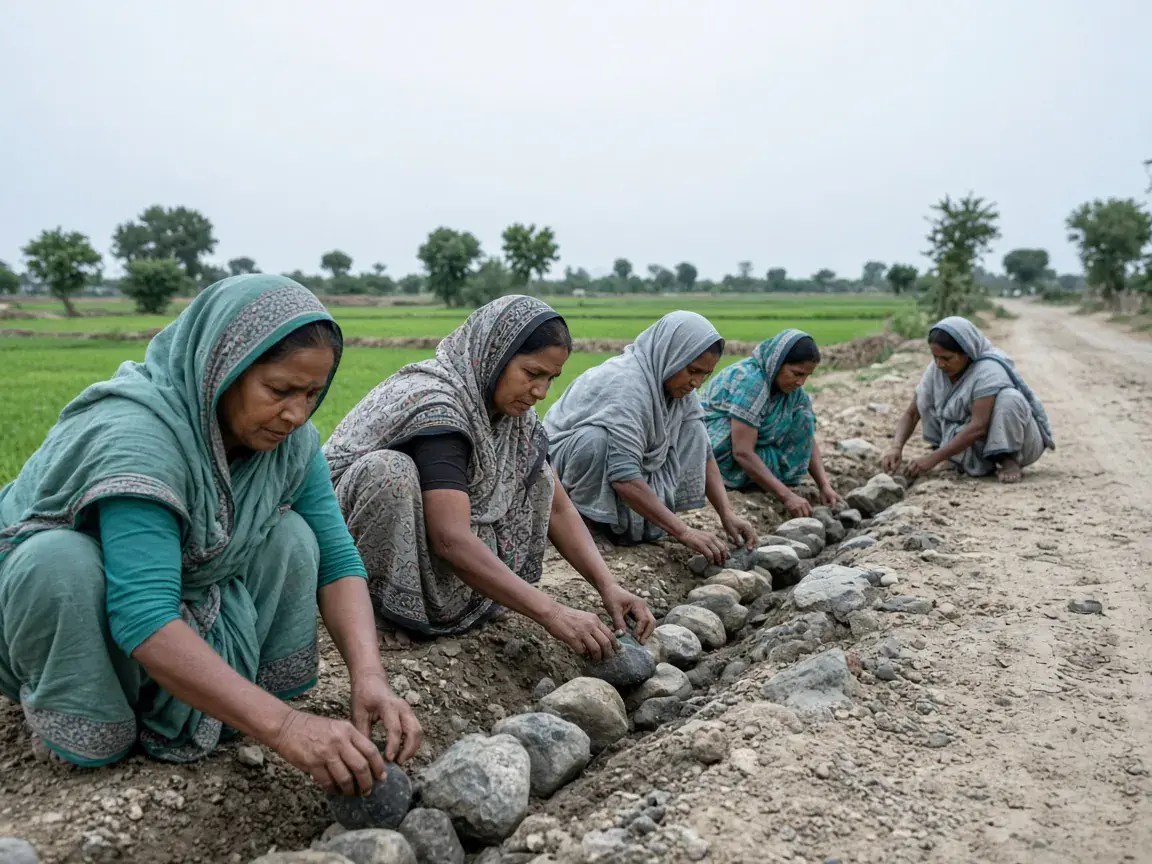
The sections below explain the change in plain language, who is eligible, how many days the law now guarantees, what kinds of works can be taken up, and who is responsible at the village, block and district. For the card itself, see the job card page. For wages, see the 2026-27 rates. For demanding work, see 125 days of work.
The 2005 Act people still search for
The 2005 Act was passed to strengthen livelihood security in rural areas by guaranteeing wage employment to households whose adult members volunteered for unskilled manual work. In everyday speech it became NREGA, then MGNREGA or MNREGA, and in Hindi, मनरेगा. The familiar features of that law are the ones you will still hear at a panchayat: a job card for the household, a written or oral demand for work, a worksite within reach of the village, a muster roll, a daily wage, payment into a bank or post office account, and a social audit.
The official guarantee under that Act was at least 100 days of work in a financial year. Many state department pages, older circulars and unofficial websites still repeat that number as if it were current. It is the right description of the old law. It is not the right description of the law in force today.
What changed on 1 July 2026
The Central Government, by Gazette notification S.O. 2383(E) dated 11 May 2026, appointed 1 July 2026 as the date on which the 2005 Act, together with the rules, notifications, schemes, orders and guidelines made under it, would stand repealed. That power was exercised under section 37(1) of the 2025 Act.
The 2025 Act came into force across all rural areas of the country from the same date. Official frequently asked questions published by the Press Information Bureau on 11 May 2026 said the change would happen everywhere at once, that employment under Mahatma Gandhi NREGA would continue in a seamless way until the new Act began, and that works already under way on the commencement date could continue and should be migrated and completed under the new law.
A Lok Sabha reply of 11 August 2026 confirmed the picture after the first weeks of the rollout: the new scheme had been implemented in rural areas of the entire country from 1 July 2026, the 2005 Act stood repealed from that date, and all States and Union Territories had notified the scheme.
The everyday work of demanding employment, marking attendance and paying wages did not stop on 30 June. What changed is the statute, the number of guaranteed days, the notified wages from 1 July 2026, some planning rules, and the name of the new household card.
| Topic | Until 30 June 2026 (2005 Act) | From 1 July 2026 (2025 Act) |
|---|---|---|
| Statute | Mahatma Gandhi National Rural Employment Guarantee Act, 2005 | VB-G RAM G Act, 2025 |
| Guaranteed days in a financial year | 100 days | 125 days |
| Household card | MGNREGA job card | Gramin Rozgar Guarantee Card (existing e-KYC job cards remain valid in the meantime) |
| Unskilled wage | Last MGNREGA notification, for 2025-26 | Gazette S.O. 3518(E) of 30 June 2026, from 1 July 2026 |
The 125-day statutory guarantee
The 2025 Act guarantees 125 days of wage employment in a financial year to every rural household whose adult members volunteer to undertake unskilled manual work. Official FAQs and the August 2026 Lok Sabha reply both set that figure against the 100 days available under Mahatma Gandhi NREGA.
125 days is a legal ceiling on the guarantee, not a promise that a household will automatically be sent to a worksite for 125 days without asking. The household still has to demand work. If work is not provided in time, unemployment allowance is the remedy, described on the demand for work page.
The financial year for counting days follows the usual official year, 1 April to 31 March. Because the new Act began on 1 July 2026, official budget material for 2026-27 often describes the first year of the new scheme as running from 1 July 2026 to 31 March 2027. For a worker, the practical step is still to ask the Gram Panchayat how many days have already been recorded for the household in the current year.
Who is eligible
Every rural household whose adult members volunteer to do unskilled manual work is eligible. That is the official eligibility sentence, and it is broad on purpose. The right is of the household, and the adults on the card are the people who can be given work.
You do not have to belong to a particular caste or income scheme to apply, and you do not apply on this website. A household that has no card yet applies at the Gram Panchayat with names, ages and address, as explained on the job card page. A household that already has an e-KYC-verified MGNREGA job card does not start from zero.
Urban households are outside this rural guarantee. People who are not willing to do unskilled manual work are also outside it; the Act is not a general unemployment dole. Skilled or semi-skilled roles that sometimes appear around a worksite are not a substitute for the unskilled guarantee.
Four kinds of works, and Viksit Gram Panchayat Plans
Official frequently asked questions group permitted works under four themes:
- Water security works
- Core rural infrastructure
- Livelihood-related infrastructure
- Extreme-weather mitigation works
Those themes are why so many worksites look like farm ponds, bunds, drains, rural roads, plantation and similar manual earthworks. The Act also allows convergence with other Central, State and local schemes, described officially as a “single-plan, multi-funding” approach. Housing work under PMAY-G can be taken up for 90 or 95 person-days of wage support, according to the applicable guidelines.
New works are not meant to be invented on the spot by a contractor. Official FAQs say that all works under the Act must come from a Viksit Gram Panchayat Plan (VGPP) prepared by the Gram Panchayat and approved by the Gram Sabha, and that incomplete works should be finished first when new work is opened, subject to those plans. Contractors cannot be engaged for works financed under the Act. As far as practicable, the work is to be done with manual labour, not with labour-displacing machines. The material component must not exceed 40% of expenditure at the district level.
A household can take part in choosing and ordering works by attending the Gram Sabha. That is also where social audit findings are discussed, as described on the social audit page.
Who runs the scheme locally
The Gram Panchayat is at the centre of the scheme: it registers households, receives applications for work, helps execute works, keeps records, and prepares the village plan. The Programme Officer at the block is an officer not below the rank of Block Development Officer. The District Programme Coordinator is the District Collector, or an equivalent officer designated by the State Government.
If work is not given in 15 days, or a wage is late, or a card is not being issued, the first official doors are therefore the Gram Panchayat and the Programme Officer — not a form on this website. Ministry pages and the working portals are listed on official portals.
Fund-sharing, in brief
VB-G RAM G is a centrally sponsored scheme. Official frequently asked questions set out the sharing pattern as 90:10 for the North-Eastern and Himalayan States, 60:40 for other States and Union Territories with a legislature, and 100% Central funding for Union Territories without a legislature. A Lok Sabha reply of 21 July 2026 names Uttarakhand, Himachal Pradesh and Jammu and Kashmir among the units on the 90:10 side, together with the North-Eastern States and Himalayan States.
Those ratios decide how the Union and the State share the cost of the scheme. They do not change the notified daily wage that is due to a worker. Budget figures quoted in Parliament in 2026, including an allocation of ₹95,692.31 crore for the new scheme in 2026-27 from 1 July to 31 March, are context for the rollout; they are not a household entitlement.
What has not changed in daily life
A household still goes to the Gram Panchayat to be registered and to demand work. Attendance is still kept on a muster. The wage is still a notified daily rate, paid into an account, not as a weekly cash packet at the bund. Social audit and public records still matter. Contractors are still not allowed to take over works financed under the Act.
What you should not do is treat a pre-2026 pamphlet as a complete description of your rights today. The number of guaranteed days, the wage schedule from 1 July 2026, the name of the new card, the four official work themes, and the agricultural-season pause are all current-law points. If a wall poster in the panchayat still says “100 days”, ask the secretary or the Programme Officer to put the current 125-day entitlement beside it, and keep a written demand if you are approaching or passing 100 days in the same financial year.
The Ministry of Rural Development is still the Union ministry. State rural development departments still notify the State scheme and still appoint the Programme Officer and the District Programme Coordinator. Official portals have moved, in at least one confirmed case, from a nic.in entry point to a dord.gov.in host; the official portal page records that redirect so that a bookmark to nrega.nic.in does not look like a broken or unofficial site.
Frequently asked questions
Has MGNREGA ended?
The 2005 Act has been repealed from 1 July 2026. The employment guarantee has not been withdrawn. It continues under the 2025 Act, with more guaranteed days and a new wage notification.
Do I have to use the new name to get work?
No. Demand work at the Gram Panchayat in the words you use every day. The office is responsible for recording the demand under the current scheme.
Is the guarantee 100 days or 125 days?
125 days in a financial year, from 1 July 2026.
Are old works still being paid?
Official guidance says works already under way on the commencement date may continue under the new Act and should be prioritised for completion.
Related pages
MGNREGA job card and the Gramin Rozgar Guarantee Card
Existing e-KYC job cards stay valid until a Gramin Rozgar Guarantee Card is issued. New households apply at the Gram Panchayat, not on this website.
MGNREGA wage rates for 2026-27, state by state
Official unskilled wage rates from Gazette S.O. 3518(E), dated 30 June 2026, effective 1 July 2026. Calculate wages for up to 125 days in your State.
125 days of work: how to demand employment
Eligible rural households can demand 125 days of work in a financial year. Employment is due in 15 days, or unemployment allowance is payable.
Official MGNREGA and NREGA portals, lists and reports
nrega.nic.in now sends you to nrega.dord.gov.in. Use official .gov.in or .nic.in sites for job-card lists, muster rolls and payment reports.